

KRAS G12D Inhibition
KRAS G12D: The Most Common Oncogene Associated with More Aggressive Cancers
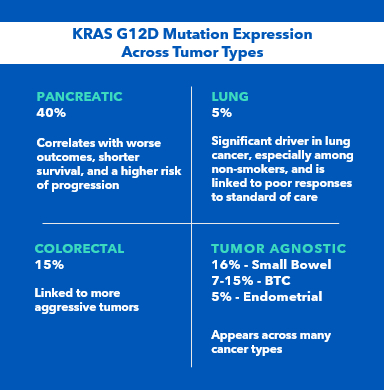
KRAS G12D is the most prevalent KRAS mutation in human cancer, accounting for approximately 26% of all KRAS mutations. It is found in some of the most challenging solid tumor types including pancreatic, non-small cell lung, colorectal, and other solid tumors.
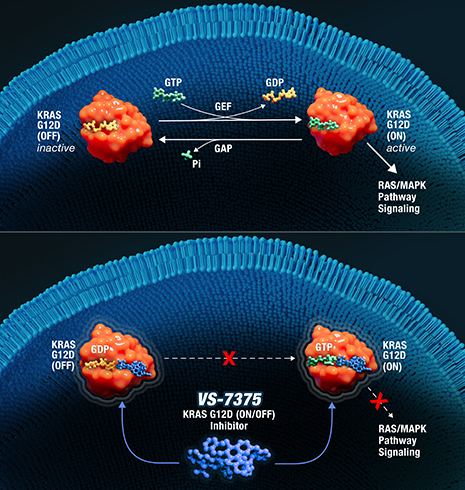
KRAS in an active state drives continuous signaling through the RAS pathway resulting in tumor growth. Patients with KRAS G12D-mutant tumors often have poorer outcomes, underscoring the need for therapies designed specifically to inhibit this mutation potently and for a long duration.
VS-7375 is an investigational, potent, selective, oral KRAS G12D inhibitor designed to engage across its active (ON) and inactive (OFF) states with the potential to treat advanced KRAS G12D solid tumors.
VS-7375: A Differentiated Approach to KRAS G12D Inhibition
VS-7375 is a potent, selective, oral small-molecule inhibitor designed to engage KRAS G12D directly while sparing wild-type KRAS signaling across both its active, GTP-bound (ON), and inactive, GDP-bound (OFF), states. In preclinical studies, this dual-state binding approach has shown exceptionally high target affinity and an extended residence time on KRAS G12D of approximately 18–24 hours.
In preclinical KRAS G12D pancreatic cancer models, VS-7375 demonstrated sustained tumor regression. In contrast, comparator KRAS G12D and pan-RAS on-state-only inhibitors lost anti-tumor activity and exhibited tumor outgrowth by approximately day 20.
Wild-type RAS signaling plays a key role in T-cell activation and proliferation. Broad RAS pathway inhibition has been shown to impair T-cell proliferation. Specific inhibition of KRAS G12D mutation by VS-7375 may help maintain anti-tumor immune function supporting more durable responses.
VS-7375 may enable a differentiated tolerability profile, which is better than less selective approaches that broadly inhibit the RAS pathway. A more tolerable profile may support longer duration of therapy and a better side effect profile, both critical factors in achieving meaningful outcomes.
Accelerating Clinical Development of VS-7375
Strong and consistent preclinical findings have supported the progression of VS‑7375 into clinical development. The FDA has granted VS-7375 Fast Track designation for the treatment of advanced KRAS G12D-mutant pancreatic ductal adenocarcinoma (PDAC).
VS-7375 is currently being evaluated in Verastem-sponsored TARGET-D clinical trials to further understand its safety, tolerability, and clinical activity as both a monotherapy and as part of broader combination treatment strategies in advanced KRAS G12D solid tumors, including PDAC, non-small cell lung, and colorectal cancers.